Data Centre Site Assessments & Feasibility Studies in Melbourne
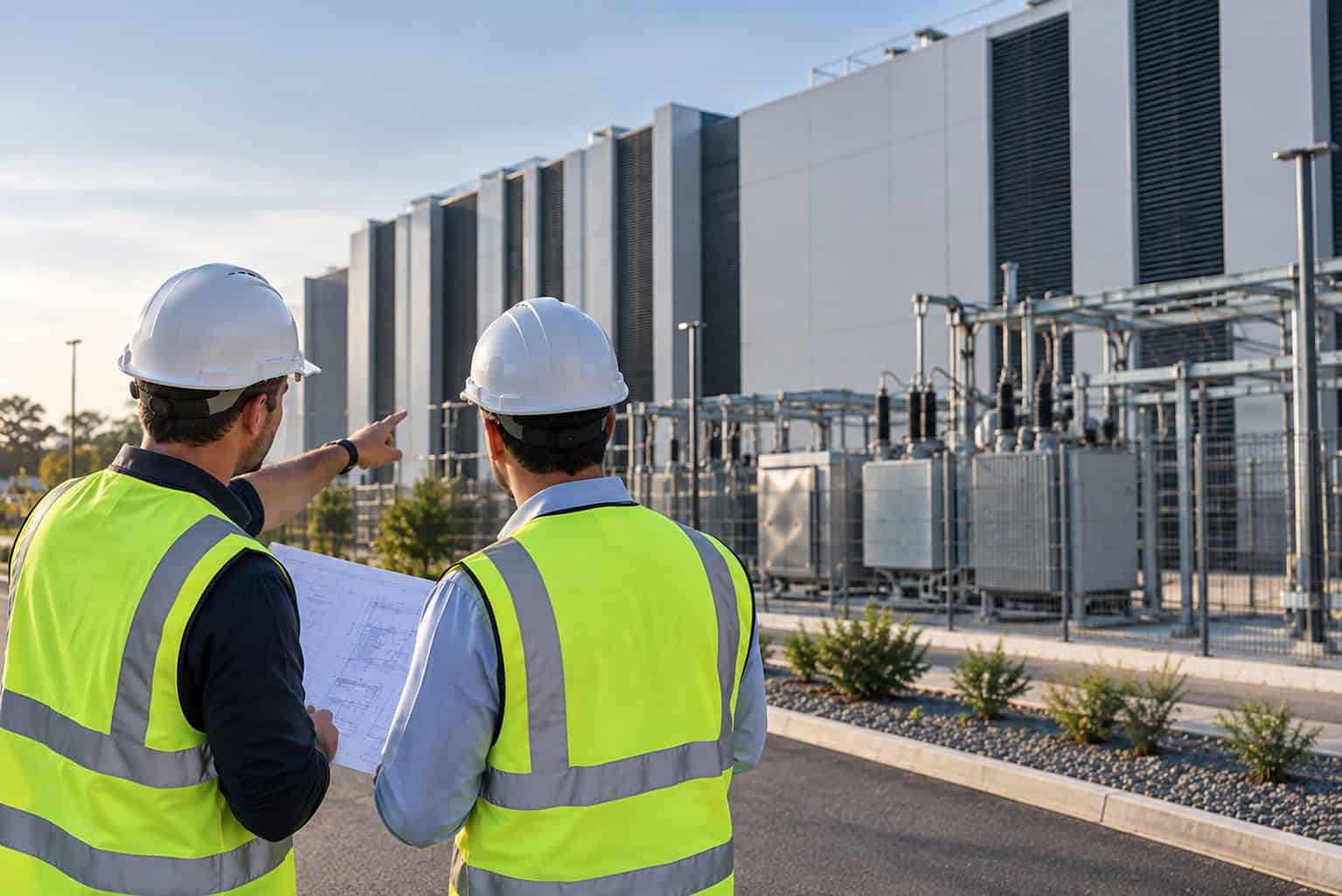
ARA Electrical Services carries out electrical site assessments and feasibility studies for data centre developments. DNSP connection strategy, network capacity, HV reticulation, redundancy modelling and earthing are assessed and reported before land or design commitments are made.
Why Assess Before Committing
Grid capacity at a proposed connection point is rarely what it first appears to be, and augmentation triggered by a DNSP can add years to a programme if it is identified late. Earthing and lightning protection requirements shift with local ground conditions. Redundancy commitments made at design stage are only as good as the network capacity feeding them. These are the variables that determine whether a site actually works, and they are cheaper to resolve before a connection point is locked in than after.
What Our Assessment Covers
Power Availability And Grid Capacity
Investigation of network capacity at the proposed connection point, augmentation requirements, and realistic connection lead times, working directly with the relevant DNSP where required.
DNSP Engagement And Connection Strategy
Every state's distribution network is administered differently, and the connection pathway for a load of data centre scale needs to be understood early, not discovered midway through design. Our assessment identifies the responsible Distribution Network Service Provider for the site. In Victoria this means AusNet Services, CitiPower, Powercor or United Energy, depending on network area. We work through the applicable connection process under Chapter 5A of the National Electricity Rules (Basic, Standard or Negotiated Connection Offer, depending on load size and complexity), and apply the same approach nationally, engaging the relevant DNSP for the site's state or territory.
For loads at data centre scale, this almost always sits in Negotiated Connection Offer territory, which means engaging the DNSP through a Preliminary Enquiry and Detailed Enquiry process rather than a standard application. We assess:
- Available zone substation and feeder capacity at the nearest points of supply, and whether existing infrastructure has headroom or requires augmentation.
- Take-off point options, whether supply is via a tee-off an existing HV feeder, a dedicated feeder run from a zone substation, or (for larger loads) a new zone substation or direct terminal station connection.
- Firm vs non-firm capacity and network redundancy at the DNSP level, which feeds directly into the facility's own N+1/2N strategy. A site fed from a single non-firm feeder cannot deliver the resilience a 2N internal design promises.
- Augmentation cost-sharing and timing, including who bears the cost of network augmentation, indicative lead times for any required works, and how that sequences against the facility construction programme.
- Embedded network considerations for large multi-building or campus-style sites, including metering and retail implications.
- Connection agreement obligations, including protection requirements, power quality/harmonic limits, and any conditions the DNSP will place on the connection.
Getting this engagement right early is often the single biggest determinant of programme risk on a data centre development. Augmentation works triggered by a DNSP can run to multi-year lead times in constrained network areas, and that risk needs to be identified and priced into the feasibility assessment, not discovered after design has locked in a connection point.
HV Reticulation Strategy
Assessment of substation location and sizing, HV cabling routes, and reticulation approach across the site from the take-off point to internal distribution, including staged capacity for future expansion.
Redundancy And Resilience Planning
Electrical infrastructure redundancy modelling at the level required for the facility's target tier or availability commitment. N+1, 2N or site-specific configurations.
Load Assessment And Modelling
Maximum demand calculations based on IT load, mechanical/cooling load, and site services, used to size incoming supply and internal distribution correctly from the outset.
Earthing And Lightning Protection
Site-specific earthing system design considerations and lightning protection risk assessment in line with AS/NZS 1768 and AS/NZS 3000/61439 requirements.
Hazardous Areas
Classification review for generator fuel storage, battery rooms and associated plant, where applicable to the site.
Feasibility Reporting
A consolidated report setting out findings, risks, indicative costs and infrastructure recommendations, suitable for board or investment committee sign-off.
Who This Is For
Developers, hyperscalers, colocation operators and investment teams evaluating a site, or comparing several sites, ahead of land acquisition or design commencement.
Why ARA Electrical Services
ARA Electrical's engineering team carries out this work as an extension of our broader electrical engineering and design capability, the same team that delivers detailed HV/LV design, fault level and arc flash studies, and switchboard design for industrial and commercial projects. A feasibility study from ARA Electrical Services isn't a desktop exercise handed off elsewhere. It's produced by the engineers who understand what's actually required to build, connect and commission the infrastructure afterward.
Considering A Data Centre Development?
Talk to our engineering team before you commit.